
A car accident can change everything in seconds.
One moment you are driving normally. The next moment, there may be damaged vehicles, injuries, police reports, ambulance bills, insurance calls, missed work, rental car issues, medical appointments, and stress about what to do next.
In the first few hours and days after a crash, your decisions matter. What you say, what evidence you collect, whether you get medical care, how you talk to insurance companies, and when you contact a car accident lawyer can affect your claim.
A car accident lawyer helps injured drivers, passengers, pedestrians, cyclists, and families understand their rights after a crash. The lawyer may investigate fault, collect evidence, communicate with insurance companies, review medical records, calculate damages, negotiate settlement offers, and file a lawsuit if needed.
Many injury lawyers work on a contingency fee arrangement. The American Bar Association explains that in a contingent fee arrangement, the lawyer agrees to accept a fixed percentage of the recovery, and if the client loses, the attorney usually does not receive a fee for the work done on the case.
This guide explains what to do after a car crash, when to call a car accident lawyer, how claims usually work, what evidence matters, what mistakes to avoid, and how to choose the right attorney for your case.
Important Legal Disclaimer
This article is for general informational purposes only. It is not legal advice and does not create an attorney-client relationship.
Car accident laws, insurance rules, filing deadlines, fault rules, damages, and claim procedures vary by state, country, and case type. Always consult a qualified attorney licensed in your area before making legal decisions.
What Is a Car Accident Lawyer?
A car accident lawyer is an attorney who helps people involved in vehicle crashes. These lawyers usually handle claims involving injuries, property damage, insurance disputes, negligence, and settlement negotiations.
A car accident lawyer may help with cases involving:
- Rear-end collisions
- Head-on crashes
- Side-impact accidents
- Multi-vehicle crashes
- Hit-and-run accidents
- Uninsured drivers
- Underinsured drivers
- Drunk driving crashes
- Distracted driving crashes
- Rideshare accidents
- Pedestrian injuries
- Bicycle accidents
- Motorcycle crashes
- Commercial vehicle crashes
- Delivery driver accidents
- Fatal crashes
- Serious injury claims
The main goal is to help the injured person recover compensation for losses caused by the crash, when the law allows it.
What to Do Immediately After a Car Accident
The first priority after any crash is safety.
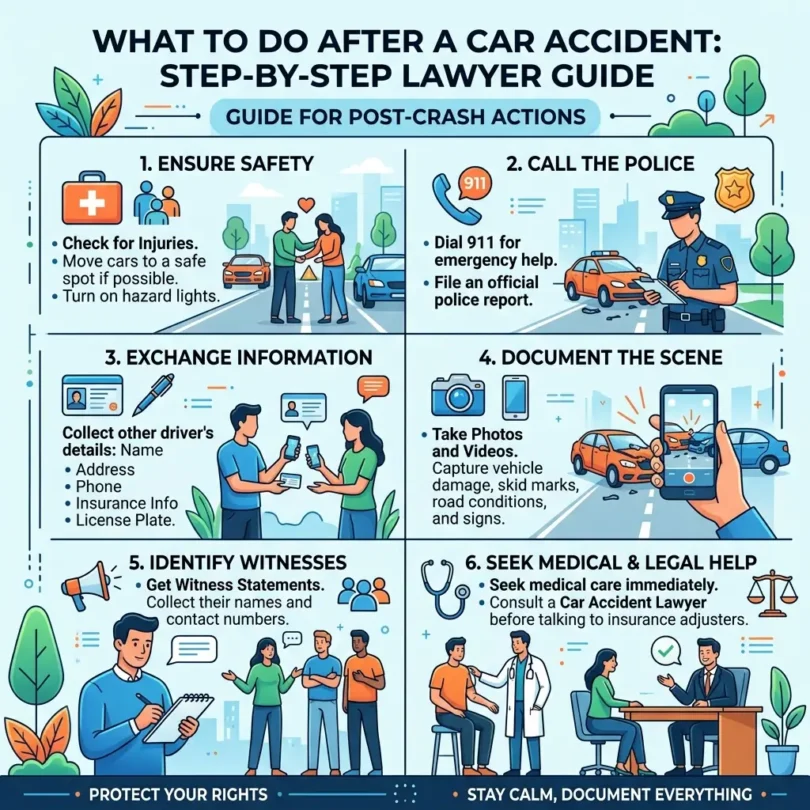
Here are the steps most people should consider after a car accident.
1. Check for Injuries
Check yourself, passengers, and others involved.
Call emergency services immediately if anyone is injured, unconscious, bleeding, dizzy, trapped, confused, or in pain.
Even if injuries seem minor, do not ignore symptoms. Some injuries appear hours or days later, especially whiplash, concussion symptoms, back pain, soft tissue injuries, internal injuries, and emotional trauma.
2. Move to a Safe Location If Possible
If the vehicles are causing danger and can be moved safely, move to the side of the road or a safer area.
If the vehicle cannot be moved, turn on hazard lights and stay away from traffic if it is safe to do so.
Do not put yourself in danger while checking damage or taking photos.
3. Call the Police
In many places, police reports are important after crashes involving injury, major damage, hit-and-run, intoxication, uninsured drivers, or disputed fault.
A police report may include:
- Date and time
- Crash location
- Driver information
- Vehicle details
- Insurance information
- Witness statements
- Officer observations
- Citations
- Diagram or crash description
A police report is not always final proof of fault, but it can be important evidence.
4. Exchange Information
Exchange information with the other driver.
Collect:
- Full name
- Phone number
- Address
- Driver’s license information
- License plate number
- Insurance company
- Policy number
- Vehicle make and model
- Vehicle color
- Owner information, if different from driver
Do not argue about fault at the scene. Stay calm and collect information.
5. Take Photos and Videos
If it is safe, take photos and videos before vehicles are moved.
Capture:
- Vehicle damage
- Vehicle positions
- Road conditions
- Skid marks
- Traffic signs
- Traffic signals
- Lane markings
- Weather conditions
- Visible injuries
- Debris
- Dashcam position
- License plates
- Insurance cards
- Driver documents
- Nearby businesses or cameras
Photos can become very important if the other driver later changes their story.
6. Get Witness Information
If anyone saw the crash, ask for their name and contact information.
Witnesses may include:
- Other drivers
- Passengers
- Pedestrians
- Store employees
- Nearby residents
- Rideshare passengers
- Cyclists
- Security guards
Independent witnesses can help when fault is disputed.
7. Get Medical Care
Medical care is important for your health and your claim.
Do not delay treatment if you feel pain, dizziness, headache, numbness, neck stiffness, back pain, confusion, nausea, or weakness.
Medical records can connect your injuries to the crash. Delayed treatment may give the insurance company an argument that the injury was not serious or not related.
8. Notify Your Insurance Company
Most policies require timely notice after an accident.
When reporting the crash, give basic facts. Avoid guessing, exaggerating, admitting fault, or giving recorded statements before you understand your rights.
If you are injured or the crash is serious, speak with a lawyer before detailed claim discussions.
9. Preserve Evidence
Keep everything related to the crash.
Save:
- Police report number
- Photos and videos
- Medical records
- Hospital discharge papers
- Prescriptions
- Repair estimates
- Rental car receipts
- Towing bills
- Insurance letters
- Emails
- Text messages
- Work absence records
- Dashcam footage
- Witness contacts
Evidence can disappear quickly, especially video footage from nearby businesses or traffic cameras.
10. Contact a Car Accident Lawyer If Needed
Not every minor accident requires a lawyer. But if there are injuries, disputed fault, low settlement offers, uninsured drivers, serious vehicle damage, or long-term medical issues, a lawyer can help protect your rights.
When Should You Hire a Car Accident Lawyer?
You should strongly consider speaking with a car accident lawyer if:
- You were injured
- Someone died in the crash
- Fault is disputed
- The other driver blames you
- The insurance company denies the claim
- The settlement offer seems too low
- You need ongoing medical treatment
- You missed work because of injuries
- The other driver was uninsured
- Multiple vehicles were involved
- A commercial vehicle was involved
- A rideshare vehicle was involved
- A drunk or distracted driver caused the crash
- Your injuries may be permanent
- You feel pressured to sign papers
- You do not understand the insurance process
- The crash involved a child passenger
- You received a lawsuit notice
A lawyer can evaluate the case, explain your options, and help avoid mistakes that may reduce your claim.
What a Car Accident Lawyer Can Do for You
A car accident lawyer may help with many parts of the claim.
Investigate the Crash
The lawyer may review police reports, photos, video footage, witness statements, vehicle damage, road conditions, and crash scene evidence.
Identify Responsible Parties
In some cases, more than one party may be responsible.
Possible parties may include:
- Another driver
- Vehicle owner
- Employer of a driver
- Trucking company
- Rideshare company, depending on facts
- Vehicle manufacturer
- Repair shop
- Government road agency, depending on law
- Bar or alcohol provider, depending on local rules
Communicate With Insurance Companies
Insurance communication can be stressful. A lawyer can handle adjusters and help prevent harmful statements.
Calculate Damages
A lawyer may calculate losses such as:
- Medical bills
- Future medical care
- Lost wages
- Reduced earning ability
- Pain and suffering
- Property damage
- Rental car costs
- Out-of-pocket expenses
- Long-term disability impact
Negotiate Settlement
A lawyer can review settlement offers and negotiate for a fairer amount.
File a Lawsuit If Needed
If settlement talks fail, the lawyer may file a lawsuit before the deadline.
Prepare for Trial
If the case does not settle, trial preparation may include depositions, expert witnesses, evidence presentation, and court filings.
Car Accident Claims: How the Process Usually Works
Every case is different, but many car accident claims follow this general process.
Step 1: Crash Happens
The accident occurs. Safety, police report, medical care, and evidence collection come first.
Step 2: Insurance Claim Begins
You or your lawyer notify the relevant insurance companies.
Step 3: Medical Treatment Continues
You receive medical care and follow treatment recommendations.
Step 4: Investigation
Fault, injuries, damages, and insurance coverage are reviewed.
Step 5: Demand Package
In many cases, the lawyer prepares a demand package with evidence, medical records, bills, lost income documentation, and settlement demand.
Step 6: Negotiation
The insurance company may accept, reject, or make a counteroffer.
Step 7: Settlement or Lawsuit
If both sides agree, the case settles. If not, a lawsuit may be filed before the legal deadline.
Step 8: Litigation
The case may enter discovery, depositions, motions, mediation, and trial preparation.
Step 9: Trial or Resolution
Most cases settle, but some go to trial.
Evidence That Can Help a Car Accident Claim
Evidence is one of the strongest parts of a claim.
Useful evidence may include:
- Police report
- Crash scene photos
- Vehicle damage photos
- Dashcam footage
- Traffic camera footage
- Business security footage
- Witness statements
- Medical records
- Emergency room records
- Doctor notes
- Physical therapy records
- Prescription records
- Lost wage documentation
- Repair estimates
- Towing bills
- Rental car receipts
- Phone records, in some cases
- Black box vehicle data, in some cases
- Expert accident reconstruction
The more serious the injury, the more important strong evidence becomes.
What Not to Say After a Crash
Words matter after an accident.
Avoid saying:
- “It was my fault.”
- “I’m fine.”
- “I’m not injured.”
- “I don’t need a doctor.”
- “I was distracted.”
- “I didn’t see them.”
- “I accept the offer.”
- “I’ll sign whatever you send.”
- “This amount is enough.”
Be polite and factual, but do not guess or admit legal responsibility at the scene.
Common Injuries After a Car Accident
Car crashes can cause many injuries, including:
- Whiplash
- Neck injuries
- Back injuries
- Concussions
- Traumatic brain injuries
- Broken bones
- Shoulder injuries
- Knee injuries
- Internal injuries
- Cuts and scarring
- Burns
- Spinal cord injuries
- Nerve damage
- Soft tissue injuries
- Psychological trauma
- Chronic pain
Some injuries are not obvious immediately. That is why medical evaluation matters.
Child Safety After a Crash
If a child was in the vehicle, child safety equipment should be checked carefully.
The National Highway Traffic Safety Administration recommends replacing car seats after moderate or severe crashes to maintain crash protection for child passengers. NHTSA says car seats do not automatically need replacement after a minor crash.
Parents should also follow manufacturer instructions and local safety rules.
How Car Accident Lawyer Fees Usually Work
Many car accident lawyers work on contingency fees.
This usually means:
- No upfront attorney fee
- Lawyer gets paid if the case succeeds
- Fee is a percentage of the recovery
- Case expenses may be separate
- Fee agreement should be in writing
The FTC explains that under a contingency fee arrangement, the client pays the lawyer a percentage of the money recovered if the case is won, and may also pay costs such as depositions, expert witnesses, filing fees, and other case expenses.
The ABA notes that contingency fees commonly involve one-third to 40 percent of the recovery, though the exact amount may vary by agreement and case type.
Before hiring a lawyer, ask exactly how fees and costs work.
Questions to Ask a Car Accident Lawyer
During a consultation, ask:
- Do you handle car accident cases regularly?
- Have you handled cases like mine?
- Who will work on my case?
- What are the strengths and weaknesses of my claim?
- What deadlines apply?
- How do you communicate with clients?
- What is your contingency fee?
- Are case expenses separate?
- What happens if we lose?
- How long could the case take?
- Should I speak with the insurance adjuster?
- What evidence should I preserve?
- What medical records do you need?
- Could my case go to court?
- What should I avoid doing?
A good attorney should answer clearly and honestly.
How to Choose the Best Car Accident Lawyer
1. Choose Relevant Experience
Look for an attorney who regularly handles car crash claims, not just any general lawyer.
2. Check Local Licensing
The lawyer should be licensed in your state or region.
3. Review Reputation
Check client reviews, bar status, discipline history, and professional background.
4. Ask About Trial Experience
Even if the case settles, trial readiness can matter.
5. Understand Fees
Ask for a written fee agreement.
6. Compare Communication
Choose a lawyer who explains things clearly.
7. Avoid Guarantees
No lawyer should promise a specific settlement amount.
8. Look for Resources
Serious cases may require experts, investigation, and litigation costs.
Mistakes to Avoid After a Car Accident
Mistake 1: Leaving the Scene Too Early
Stay as required by law and exchange information.
Mistake 2: Not Calling Police
A police report can be important, especially when fault is disputed.
Mistake 3: Not Getting Medical Care
Delays can hurt both health and claim strength.
Mistake 4: Admitting Fault
Do not make legal conclusions at the scene.
Mistake 5: Giving a Recorded Statement Too Soon
Speak with a lawyer if you are unsure.
Mistake 6: Posting on Social Media
Insurance companies may review public posts.
Mistake 7: Accepting the First Offer
Early offers may not include future treatment or long-term effects.
Mistake 8: Missing Deadlines
Every location has filing deadlines.
Mistake 9: Losing Evidence
Save photos, records, bills, and messages.
Mistake 10: Not Reading Settlement Papers
A release may permanently end your claim.
What If the Other Driver Has No Insurance?
If the other driver is uninsured or underinsured, options may include:
- Your uninsured motorist coverage
- Your underinsured motorist coverage
- Collision coverage
- Medical payments coverage
- Personal injury protection, depending on location
- Lawsuit against the driver
- Other responsible parties, if any
Insurance coverage rules vary widely, so legal advice is important.
What If You Were Partly at Fault?
Many places have rules about shared fault.
Depending on local law, being partly at fault may reduce or prevent recovery. The exact rule depends on the state or country.
This is one reason not to admit fault without understanding the legal standard.
What If the Crash Involved a Rideshare Driver?
Rideshare accidents may involve companies such as Uber or Lyft, but coverage depends on what the driver was doing at the time.
Important questions include:
- Was the app on?
- Was the driver waiting for a ride request?
- Was the driver on the way to pick someone up?
- Was a passenger in the vehicle?
- Was another driver responsible?
- Which insurance policy applies?
Rideshare cases can be complex, so legal guidance is often helpful.
What If the Crash Involved a Commercial Vehicle?
Commercial vehicle crashes can involve:
- Company drivers
- Delivery vehicles
- Trucks
- Vans
- Buses
- Employer liability
- Maintenance records
- Driver logs
- Commercial insurance
- Federal or local transportation rules
These cases may require fast evidence preservation.
How Long Does a Car Accident Claim Take?
A claim may take weeks, months, or longer.
Timeline depends on:
- Injury severity
- Medical treatment length
- Insurance cooperation
- Fault dispute
- Number of parties
- Evidence availability
- Settlement negotiations
- Court schedule
- Whether lawsuit is filed
Do not rush settlement before understanding the full injury impact.
Final Verdict: When Do You Need a Car Accident Lawyer?
You may not need a lawyer for a very minor crash with no injuries and simple property damage.
But you should consider a car accident lawyer if there are injuries, disputed fault, serious vehicle damage, low settlement offers, uninsured drivers, commercial vehicles, rideshare issues, missed work, long-term symptoms, or pressure from insurance companies.
A good car accident lawyer can help investigate the crash, protect deadlines, collect evidence, handle insurance communication, estimate damages, negotiate settlement, and prepare for court if needed.
After a crash, your first steps should be safety, medical care, police report, evidence collection, and careful communication.
The right attorney can help you avoid mistakes and make informed decisions during a stressful time.
FAQs About Car Accident Lawyers
What does a car accident lawyer do?
A car accident lawyer helps injured people after a crash by investigating fault, collecting evidence, dealing with insurance companies, reviewing medical records, negotiating settlements, and filing lawsuits when needed.
When should I hire a car accident lawyer?
You should consider hiring a lawyer if you were injured, fault is disputed, the insurance company denies or undervalues the claim, the crash involved an uninsured driver, or the case involves serious damages.
How much does a car accident lawyer cost?
Many car accident lawyers work on contingency fees. The ABA explains that in a contingent fee arrangement, the attorney receives a fixed percentage of the recovery if the case succeeds.
What percentage do car accident lawyers usually take?
The ABA states that contingency fees often range from one-third to 40 percent of the recovery, though the exact amount depends on the agreement and case.
Should I talk to the insurance company after a crash?
You may need to report the crash, but be careful with detailed statements, recorded interviews, or settlement agreements. If you are injured or unsure, speak with a lawyer first.
What evidence should I collect after a car accident?
Collect photos, videos, police report information, witness contacts, insurance details, medical records, repair estimates, towing bills, rental receipts, and any written communication.
Should I go to a doctor even if I feel okay?
Yes, if you have pain, dizziness, headache, stiffness, confusion, numbness, or any concerning symptoms. Some injuries appear later, and medical records can be important.
Do all car accident claims go to court?
No. Many claims settle before trial. However, a lawyer should be prepared to file a lawsuit if settlement offers are unfair.
What if the other driver does not have insurance?
You may have options through uninsured motorist coverage, underinsured motorist coverage, collision coverage, medical payments coverage, or other legal claims depending on local law and policy terms.
Where can I find affordable legal help?
USA.gov lists resources for free or low-cost legal help, including LawHelp.org, Legal Services Corporation organizations, and law school pro bono programs.