

Medical care requires trust.
Patients trust doctors, nurses, hospitals, surgeons, pharmacists, clinics, emergency rooms, specialists, nursing homes, and healthcare systems with their health and safety. Most healthcare professionals work hard to help patients. But sometimes serious mistakes happen.
A medical error does not automatically mean there is a malpractice case. Bad outcomes can happen even when doctors follow proper standards. But when a healthcare provider fails to meet accepted medical standards and a patient is harmed as a result, the patient or family may have the right to speak with a medical malpractice lawyer.
Medical malpractice cases can involve surgical mistakes, birth injuries, delayed diagnosis, misdiagnosis, medication errors, anesthesia problems, hospital infections, emergency room mistakes, nursing home negligence, failure to monitor, failure to treat, or failure to explain serious risks.
Medical malpractice claims are usually complex. They often require medical records, expert review, strict deadlines, and detailed proof of how the provider’s conduct caused harm.
Medical errors can involve failures in diagnosis, treatment, medication use, communication, surgery, infection prevention, and patient monitoring. The World Health Organization identifies common adverse events that may result in avoidable patient harm, including medication errors, unsafe surgical procedures, healthcare-associated infections, diagnostic errors, patient falls, pressure ulcers, patient misidentification, unsafe blood transfusion, and venous thromboembolism. (World Health Organization)
This guide explains when to contact a medical malpractice lawyer, what may count as malpractice, what evidence matters, how claims usually work, what questions to ask an attorney, and what mistakes to avoid.
Important Legal and Medical Disclaimer
This article is for general informational purposes only. It is not legal advice, medical advice, diagnosis, treatment guidance, or a substitute for speaking with a qualified professional.
Medical malpractice laws, deadlines, expert witness requirements, damage rules, filing procedures, and attorney fee rules vary by location. Medical issues also depend on individual facts and health conditions. Always consult a qualified attorney licensed in your area and appropriate healthcare professionals before making decisions.
What Is a Medical Malpractice Lawyer?
A medical malpractice lawyer is an attorney who represents patients or families in claims involving alleged medical negligence.
These lawyers usually handle claims against healthcare providers such as:
- Doctors
- Surgeons
- Nurses
- Hospitals
- Emergency rooms
- Clinics
- Dentists
- Pharmacists
- Anesthesiologists
- Obstetricians
- Nursing homes
- Medical groups
- Urgent care centers
- Specialists
- Radiologists
- Laboratories
A medical malpractice lawyer may help by:
- Reviewing medical records
- Investigating what happened
- Consulting medical experts
- Checking legal deadlines
- Identifying responsible providers
- Explaining possible claims
- Preparing legal filings
- Handling settlement discussions
- Representing the patient in court if needed
Because these cases involve both law and medicine, not every injury lawyer handles them. Medical malpractice claims often require specialized knowledge, expert witnesses, and significant case preparation.
What Is Medical Malpractice?
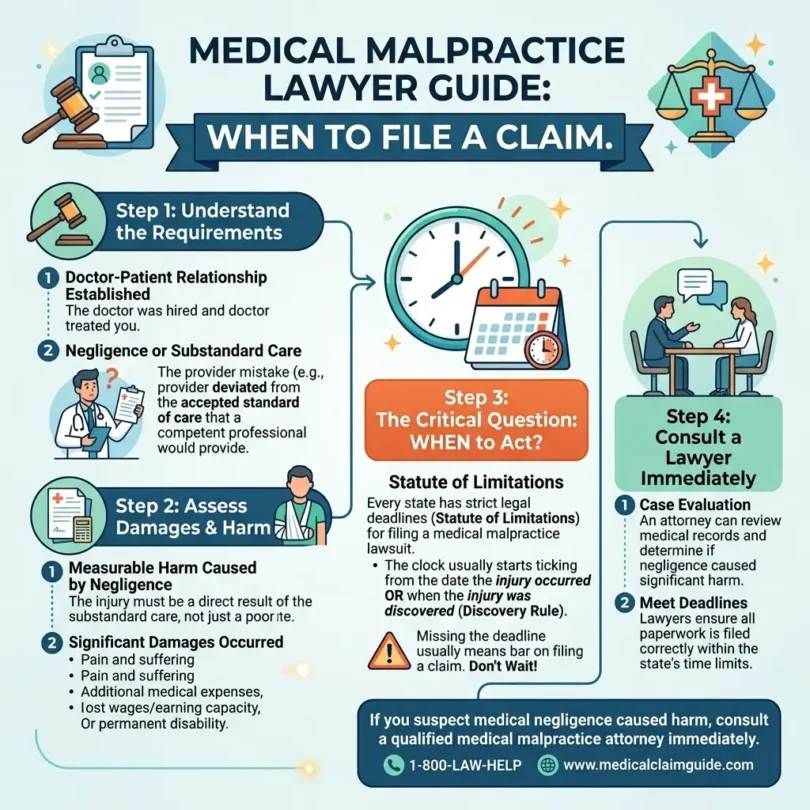
Medical malpractice usually means that a healthcare provider failed to meet the accepted standard of care and that failure caused harm to the patient.
In simple words, a malpractice claim usually requires four key elements:
- A provider-patient relationship existed.
- The healthcare provider failed to follow the accepted standard of care.
- That failure caused harm.
- The patient suffered damages because of the harm.
A poor result alone is usually not enough. The key question is whether the provider’s actions were below the standard expected from a reasonably careful healthcare provider under similar circumstances.
The National Center for Biotechnology Information notes that the Institute of Medicine defined medical error as the failure to complete an intended plan of action or using the wrong plan to achieve an intended outcome. It also notes that some experts describe medical errors as deviations from the standard care process that may or may not result in patient injury. (NCBI)
Not every medical error becomes a lawsuit. A medical malpractice lawyer can help evaluate whether the facts may support a legal claim.
When Should You Contact a Medical Malpractice Lawyer?
You should consider speaking with a medical malpractice lawyer if you believe a medical provider’s mistake caused serious harm.
Below are common situations where legal review may be important.
1. Misdiagnosis or Delayed Diagnosis
A diagnosis mistake can have serious consequences.
Examples may include:
- Cancer diagnosis delay
- Heart attack misdiagnosed as indigestion
- Stroke symptoms ignored
- Infection not recognized
- Fracture missed on imaging
- Blood clot not diagnosed
- Appendicitis missed
- Sepsis warning signs ignored
- Lab results not reviewed
- Serious symptoms dismissed
Not every missed diagnosis is malpractice. The question is whether a reasonably careful provider should have identified the condition earlier based on symptoms, tests, history, and available information.
A lawyer may review whether the delay caused worse harm, reduced treatment options, or changed the patient’s outcome.
2. Surgical Error
Surgical errors may involve serious and sometimes permanent harm.
Examples include:
- Wrong-site surgery
- Wrong procedure
- Surgical instrument left inside the body
- Nerve injury
- Organ damage
- Anesthesia complication
- Failure to control bleeding
- Post-surgery infection
- Poor post-operative monitoring
- Failure to recognize complications
Surgical cases often require expert review because not every complication is negligence. A malpractice attorney can help determine whether the complication was a known risk or a preventable error.
3. Medication Error
Medication mistakes can happen in hospitals, pharmacies, clinics, nursing homes, and emergency rooms.
Examples include:
- Wrong medication
- Wrong dose
- Dangerous drug interaction
- Allergy ignored
- Medication given to wrong patient
- Incorrect prescription
- Pharmacy dispensing mistake
- Failure to monitor side effects
- Medication stopped improperly
MedlinePlus advises patients to reduce medical error risk by asking questions, bringing a friend or relative to appointments when helpful, telling healthcare providers about all medicines and allergies, and making sure they understand how to take medications correctly. (MedlinePlus)
If a medication error caused serious harm, speak with a lawyer and a healthcare professional.
4. Birth Injury
Birth injury cases can involve harm to the mother, baby, or both.
Examples may include:
- Failure to monitor fetal distress
- Delayed C-section
- Improper use of forceps or vacuum
- Shoulder dystocia errors
- Failure to diagnose maternal infection
- Failure to manage bleeding
- Oxygen deprivation
- Newborn brain injury
- Failure to monitor high-risk pregnancy
Birth injury cases are often highly complex and require obstetric, pediatric, neurology, and life-care experts.
5. Emergency Room Mistake
Emergency rooms are high-pressure environments, but providers must still follow appropriate standards.
Potential ER malpractice issues may include:
- Failure to diagnose stroke
- Failure to diagnose heart attack
- Failure to diagnose sepsis
- Patient discharged too early
- Serious symptoms not investigated
- Test results ignored
- Failure to monitor vital signs
- Medication error
- Delayed treatment
These claims often depend on what information was available at the time and what a reasonably careful emergency provider should have done.
6. Hospital Negligence
Hospitals may be involved in claims related to staffing, supervision, infection control, nursing care, medication systems, discharge planning, or failure to monitor.
Examples include:
- Patient falls
- Pressure ulcers
- Healthcare-associated infections
- Failure to monitor after surgery
- Poor communication between providers
- Failure to respond to abnormal test results
- Medication administration errors
- Unsafe discharge
WHO lists healthcare-associated infections, patient falls, pressure ulcers, diagnostic errors, medication errors, and unsafe surgical procedures among common adverse events that may lead to avoidable patient harm. (World Health Organization)
7. Anesthesia Error
Anesthesia errors can be serious.
Examples include:
- Incorrect dosage
- Failure to monitor oxygen levels
- Failure to review allergies
- Failure to review medical history
- Intubation injury
- Poor response to anesthesia complications
- Awareness during surgery
- Delayed recognition of distress
These cases require expert review from qualified medical professionals.
8. Nursing Home Neglect
Medical malpractice or negligence claims may arise in nursing homes when residents suffer harm because of poor care.
Examples include:
- Falls
- Bedsores
- Dehydration
- Medication mistakes
- Infections
- Poor supervision
- Failure to treat wounds
- Failure to call a doctor
- Malnutrition
- Physical injury
- Neglect of medical needs
Families should document concerns and speak with legal and medical professionals if serious harm occurs.
Medical Malpractice vs Bad Medical Outcome
This is an important difference.
A bad outcome is not always malpractice.
Medical treatment can fail even when providers act carefully. Surgery can have known risks. Some illnesses are difficult to diagnose. Some complications happen despite proper care.
A malpractice case usually requires proof that:
- The provider owed a duty of care
- The provider failed to meet the standard of care
- That failure caused harm
- The patient suffered damages
For example:
- A patient has a known surgical complication despite proper technique: may not be malpractice.
- A surgeon operates on the wrong body part: may strongly suggest malpractice.
- A cancer diagnosis is delayed despite clear warning signs and ignored test results: may require legal review.
- A condition was rare and not reasonably detectable earlier: may not be malpractice.
A medical malpractice lawyer can help review the difference.
What Evidence Matters in a Medical Malpractice Claim?
Medical malpractice claims depend heavily on evidence.
Important evidence may include:
- Medical records
- Hospital records
- Doctor notes
- Nursing notes
- Lab results
- Imaging reports
- Medication records
- Surgical reports
- Anesthesia records
- Discharge papers
- Follow-up instructions
- Photos of injuries
- Prescription bottles
- Pharmacy records
- Communication with providers
- Appointment history
- Billing records
- Second opinion reports
- Expert review
- Timeline of events
A patient or family should request complete records as early as possible.
Why Medical Records Are So Important
Medical records show what happened before, during, and after treatment.
They may reveal:
- Symptoms reported
- Tests ordered
- Test results
- Diagnosis
- Treatment decisions
- Medication given
- Provider notes
- Consent forms
- Warnings given
- Discharge instructions
- Follow-up plans
- Changes in condition
- Missed abnormal results
A malpractice lawyer usually needs records before giving a meaningful case evaluation.
How Medical Malpractice Claims Usually Work
Every case is different, but many medical malpractice claims follow this general path.
Step 1: Patient Suspects Something Went Wrong
The patient or family notices unexpected harm, worsening condition, unclear explanation, or possible medical mistake.
Step 2: Medical Care Comes First
Health and safety come first. Get follow-up care, second opinion, emergency treatment, or specialist help if needed.
Step 3: Records Are Collected
Medical records are requested from hospitals, doctors, pharmacies, clinics, and other providers.
Step 4: Lawyer Reviews the Case
The attorney reviews facts, timeline, injuries, damages, and deadlines.
Step 5: Medical Expert Review
Most malpractice cases require review by a qualified medical expert. The expert may evaluate whether the provider violated the standard of care and whether that caused harm.
Step 6: Pre-Filing Requirements
Some locations require special steps before filing, such as:
- Notice to healthcare provider
- Certificate of merit
- Expert affidavit
- Medical review panel
- Screening process
- Pre-suit investigation
Justia explains that many states require a certificate of merit or affidavit from a medical expert stating that the lawsuit has a legitimate basis before or near the time a medical malpractice claim is filed. (American Bar Association)
Step 7: Claim or Lawsuit Is Filed
If evidence supports the claim and deadlines allow it, the attorney may file the case.
Step 8: Discovery
Both sides exchange evidence, take depositions, request records, and work with experts.
Step 9: Settlement Discussions
Many cases settle, but settlement depends on evidence, damages, liability, expert opinions, and risk.
Step 10: Trial
If settlement does not happen, the case may go to trial.
Deadlines: Why You Should Not Wait
Medical malpractice claims have strict deadlines called statutes of limitations.
The deadline depends on location and case type. Some places also have special discovery rules when the patient did not immediately know malpractice may have happened. Claims involving minors, wrongful death, government hospitals, or public medical facilities may have different rules.
Waiting too long can destroy the right to file a claim.
Contact a lawyer quickly if you suspect malpractice.
How Medical Malpractice Lawyer Fees Usually Work
Many medical malpractice lawyers work on contingency fees, but rules vary by state and case type.
The American Bar Association explains that in a contingent fee arrangement, the lawyer accepts a fixed percentage of the recovery, often one-third to 40 percent; if the client loses, the attorney generally does not receive a fee for the work done on the case. (American Bar Association)
The ABA Model Rules also state that contingent fee agreements must be in writing and should explain the percentage, whether the percentage changes after settlement, trial, or appeal, what expenses may be deducted, and whether expenses are deducted before or after the fee is calculated. (American Bar Association)
Before hiring a medical malpractice lawyer, ask:
- What is the attorney fee percentage?
- Is the fee limited by state law?
- Are case costs separate?
- Who pays expert review costs?
- What happens if the case is lost?
- Are expenses deducted before or after the fee?
- Does the percentage change if the case goes to trial?
- Will the agreement be in writing?
Medical malpractice cases can be expensive because they often require expert witnesses, medical record review, depositions, and detailed preparation.
How to Choose the Best Medical Malpractice Lawyer
Choosing the right lawyer is especially important in malpractice cases.
1. Choose a Lawyer With Malpractice Experience
Do not choose only a general injury lawyer.
Medical malpractice is specialized. Ask:
- Do you regularly handle medical malpractice cases?
- Have you handled cases like mine?
- Do you work with medical experts?
- Have you taken malpractice cases to trial?
- What types of providers have you sued before?
2. Look for Case-Specific Knowledge
Different malpractice cases need different expertise.
For example:
- Birth injury requires obstetric and pediatric knowledge
- Surgical error requires surgical expert review
- Cancer delay requires oncology experts
- Medication error may require pharmacy or hospital system review
- ER mistake may require emergency medicine experts
Ask whether the lawyer has handled your specific category.
3. Ask About Expert Witnesses
Medical experts are often essential.
A strong lawyer should understand how to find and work with qualified experts.
Ask:
- Will a medical expert review my case?
- What type of expert is needed?
- Who pays expert review costs?
- What happens if the expert does not support the case?
4. Check Trial Readiness
Malpractice cases may be strongly defended by hospitals, doctors, and insurers.
Ask:
- Do you try malpractice cases?
- How often do your cases settle?
- What happens if settlement is not fair?
- Who handles depositions and court hearings?
5. Understand Communication
Medical malpractice cases can take time.
Ask:
- How often will I get updates?
- Who will be my main contact?
- Will I speak directly with an attorney?
- How do you explain medical issues to clients?
- How long may the case take?
6. Review Fee Agreement Carefully
Because malpractice cases can involve high costs, fee clarity is critical.
Ask about:
- Attorney percentage
- Expert witness costs
- Medical record costs
- Filing fees
- Deposition costs
- Trial costs
- Appeal costs
- Expense deduction method
Questions to Ask a Medical Malpractice Lawyer
Use this consultation checklist:
- Do you handle medical malpractice cases regularly?
- Have you handled cases like mine before?
- What type of medical expert would review this case?
- What records do you need?
- What deadlines apply?
- Does my location require a certificate of merit?
- What are the strongest facts in my case?
- What are the weakest facts?
- How do you prove standard of care?
- How do you prove causation?
- What damages may be available?
- What expenses are involved?
- What is your contingency fee?
- What happens if the case is lost?
- Could this case settle?
- Could this case go to trial?
- How long could it take?
- Who will communicate with me?
- Should I request a second medical opinion?
- What should I avoid doing now?
Documents to Bring to a Malpractice Consultation
Bring as much information as possible.
Useful documents include:
- Complete medical records
- Hospital records
- Test results
- Imaging reports
- Prescription records
- Surgical reports
- Discharge instructions
- Doctor notes
- Appointment timeline
- Photos of injuries
- Names of providers
- Insurance letters
- Billing statements
- Second opinion notes
- Death certificate, if applicable
- Autopsy report, if applicable
- Written timeline of events
- Texts or emails with providers
- Medication bottles or labels
A clear timeline is very helpful. Write dates, symptoms, appointments, conversations, tests, treatments, and when you first noticed harm.
Mistakes to Avoid in a Medical Malpractice Claim
Mistake 1: Waiting Too Long
Deadlines can be strict. Contact a lawyer quickly.
Mistake 2: Not Getting Follow-Up Care
Your health comes first. Do not ignore ongoing symptoms.
Mistake 3: Not Requesting Records
Complete records are essential.
Mistake 4: Posting Online About the Case
Public posts may be used against you.
Mistake 5: Assuming Every Bad Outcome Is Malpractice
You need expert review to understand whether the standard of care was violated.
Mistake 6: Signing Papers Without Legal Review
Do not sign settlement or release documents without understanding them.
Mistake 7: Not Telling the Lawyer the Full Story
Tell the lawyer about prior conditions, prior treatment, and all relevant facts.
Mistake 8: Choosing a Lawyer Without Malpractice Experience
These cases are specialized.
Mistake 9: Ignoring Expert Requirements
Many locations require expert support before filing.
Mistake 10: Expecting a Fast Case
Medical malpractice claims can take time because they require records, experts, discovery, and defense review.
What If the Patient Died?
If a patient died because of possible medical negligence, the family may need to explore a wrongful death or survival claim depending on local law.
These cases can involve:
- Death certificate
- Autopsy report
- Medical records
- Hospital timeline
- Expert review
- Family damages
- Estate representative issues
- Strict deadlines
Speak with a qualified lawyer quickly because wrongful death deadlines may differ from ordinary malpractice deadlines.
What If You Are Unsure Whether Malpractice Happened?
Many patients do not know whether the harm was malpractice, a known complication, or an unavoidable outcome.
That is normal.
You can still:
- Request medical records
- Get a second medical opinion
- Write a timeline
- Preserve documents
- Ask questions about what happened
- Speak with a malpractice lawyer
MedlinePlus encourages patients to ask questions when they have doubts or concerns and to bring a friend or relative to appointments to help ask questions and understand answers. (MedlinePlus)
A lawyer can help decide whether the case is worth expert review.
Final Verdict: When Should You File a Medical Malpractice Claim?
You should consider contacting a medical malpractice lawyer if you believe a healthcare provider’s mistake caused serious harm, worsened a condition, delayed necessary treatment, caused permanent injury, required additional medical care, or led to death.
Common warning signs include:
- Diagnosis delay
- Surgical mistake
- Medication error
- Birth injury
- Failure to monitor
- Hospital infection concern
- Emergency room mistake
- Anesthesia problem
- Wrong procedure
- Abnormal test results ignored
- Serious injury after treatment
- Unexpected death after possible medical error
The best medical malpractice lawyer should have experience with malpractice claims, access to medical experts, trial readiness, clear communication, transparent fees, and knowledge of local filing rules.
Do not wait too long. Medical malpractice deadlines can be strict, and evidence may become harder to collect over time.
If you suspect malpractice, focus first on your health, request your records, write a timeline, preserve evidence, and speak with a qualified attorney in your area.
FAQs About Medical Malpractice Lawyers
What does a medical malpractice lawyer do?
A medical malpractice lawyer helps patients or families investigate claims involving alleged medical negligence. The lawyer may review records, consult medical experts, identify responsible providers, file claims, negotiate settlements, and represent the patient in court.
What counts as medical malpractice?
Medical malpractice usually means a healthcare provider failed to meet the accepted standard of care and that failure caused harm. A bad outcome alone is usually not enough.
When should I contact a medical malpractice lawyer?
Contact a lawyer if you believe a medical mistake caused serious harm, delayed treatment, permanent injury, additional medical care, or death. You should also contact a lawyer quickly because deadlines can be strict.
How much does a medical malpractice lawyer cost?
Many malpractice lawyers use contingency fees. The ABA explains that contingency fees often mean the attorney receives a fixed percentage of the recovery, commonly one-third to 40 percent, if the case succeeds. (American Bar Association)
Do medical malpractice cases require expert witnesses?
Often yes. Many malpractice claims require medical expert review, and some locations require a certificate of merit or expert affidavit before or near filing. (American Bar Association)
Is every medical mistake malpractice?
No. Some mistakes do not cause legal harm, and some bad outcomes happen even with proper care. A malpractice case usually requires proof of standard-of-care violation and causation.
What records do I need for a malpractice claim?
You may need hospital records, doctor notes, test results, imaging reports, surgical reports, medication records, discharge instructions, billing records, and a timeline of events.
Can I sue for a delayed diagnosis?
Possibly, if the delay violated the standard of care and caused harm. These cases often require expert medical review.
Can I file a claim after a loved one dies from possible malpractice?
Possibly. Families may have wrongful death or related claims depending on local law. Speak with a qualified lawyer quickly because deadlines may be short.
Should I get a second medical opinion?
If you have concerns about your diagnosis or treatment, a second opinion may help you understand your medical situation. MedlinePlus encourages patients to ask questions when they have doubts or concerns. (MedlinePlus)